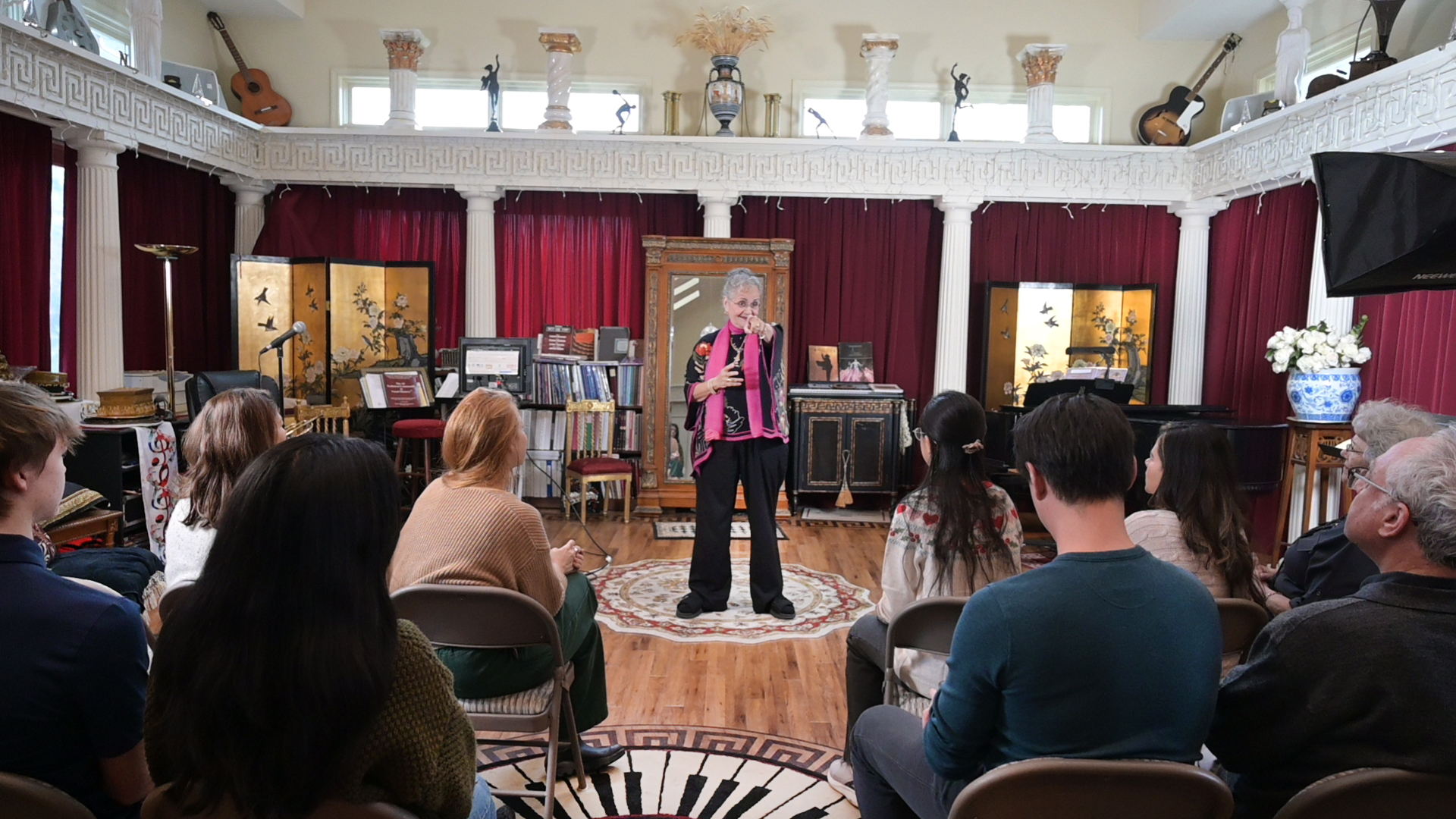
The 7 Vocal Commands are seven specific anatomical actions that every high-stakes voice user must control. Posture aligns your breathing apparatus. Inhalation directs air into six lung areas for maximum capacity. Exhalation engages the abdominal and lumbar muscles to regulate airflow. The Throat Command expands the resonating chamber by lowering the larynx and raising the soft palate. The Soft Palate Command controls nasal versus non-nasal sound. The Tongue Command positions the hardest-working muscle in vocal production. The Jaw Command stabilises diction and vowel placement. These are not hand-me-down techniques. They are physiological requirements validated by MRI imaging and fibre-optic video. When my own voice failed in my early twenties, no one could tell me what was anatomically wrong. The Commands are the system I built to fix it.
TL;DR ▸ What you need to know about the 7 Vocal Commands
- Each Command trains one specific anatomical action (posture, breathing, throat, soft palate, tongue, jaw).
- The diaphragm pulls 80% of air into six lung areas. The abdominal and lumbar muscles regulate exhalation.
- The Throat Command lowers the larynx and raises the soft palate to double the resonating chamber volume.
- Tongue position controls pitch, projection, and vowel clarity. Most singers never isolate this muscle.
- The Commands are not opinions. They are physiology I validated with MRI and fibre-optic imaging.
Why Most Voice Training Fails Without Anatomical Specificity
Most voice teachers will tell you to “open up” or “support from the diaphragm” or “let the sound flow.” That is hand-me-down advice. It might feel poetic. It will not fix your voice.
Here is what is actually happening when your high note cracks. Your soft palate has not lifted. Your larynx is riding too high in the neck. The cricothyroid muscle is not engaging to lengthen the vocal folds. The crack is the system collapsing because three muscles are not doing their job. Not because you lack support. Not because you lack talent.
I have watched this in MRI imaging for fifteen years. The fix is not mysterious. It is the Soft Palate Command and the Throat Command, trained together until the muscles obey on cue.
When my voice failed in my early twenties, I had a voice everyone said was beautiful. One day it was gone. No one could tell me what was happening anatomically. They told me to relax, to breathe, to feel it. None of that fixed it. What fixed it was learning, muscle by muscle, what was supposed to move and when. That is the origin of the 7 Vocal Commands.
The voice is a muscle. You train it. The Commands are physiology, not opinion.
Command One: Posture (The Foundation for Breathing)
Posture is not about standing up straight. It is about alignment that allows the diaphragm to descend fully and the rib cage to expand without obstruction.
When you slouch, your lungs cannot fill. The diaphragm cannot drop. The ribs twelve through five (the target areas for inhalation) stay compressed. You are singing or speaking on partial air before you even begin.
The anatomical requirement: Head balanced over the spine. Shoulders back and down. Chest lifted without arching the lower back. Feet hip-width apart, weight distributed evenly.
I see this every week. A student comes in with tension. I adjust their posture. The voice opens immediately. Not because of “energy.” Because the breathing apparatus can now function.
Command Two: Inhalation (Filling Six Lung Areas)
Inhalation is not automatic. Most people inhale into the upper chest (ribs four and five). That is too high and too shallow. It creates tension in the neck and shoulders. It cannot support serious vocal production.
The diaphragm is the most important muscle for inhalation. When you inhale, the diaphragm descends and flattens. The chest cavity enlarges. This creates a vacuum that pulls air into the lungs. How much air is pulled in depends on how low the diaphragm is pushed down.
The external intercostal muscles (the muscles between your ribs) assist by expanding the rib cage downward, outward, and slightly upward. You must learn to direct air into six specific areas:
- Lower front (ribs twelve through nine)
- Middle front (ribs eight through five)
- Lower sides (ribs twelve through nine)
- Middle sides (ribs eight through five)
- Lower back (ribs twelve through nine)
- Middle back (ribs eight through five)
Directing air into these six areas is not a natural process. It must be trained. When you master this, you will have the power and endurance to sustain long phrases, hit high notes without strain, and project without forcing.
Inhaling into the six areas will lead to optimal control of airflow and ensure a consistent, powerful, healthy, and enduring voice. It is vital that you identify and understand the significance of each one of these six areas. Having some of the six areas not sufficiently filled will throw off your entire inhalation process because you will not have enough air to support your voice.
Command Three: Exhalation (Abs and Lumbars Working Together)
Exhalation is where most singers lose control. They exhale naturally, the way we do all day long. That will not sustain your voice to be strong.
There are two sets of muscles used simultaneously for proper exhalation: the abdominal muscles and the thoracolumbar muscles (I call them the abs and the lumbars). When these two muscles work in coordination, they provide the fuel and intensity of air necessary for a strong, healthy, enduring voice.
Step one: The abdominal muscles pull inward to push air out. This is what most people think of as “breath support.”
Step two: The lumbar fascia muscles (located in the lower back sides, connected to the base of the ribs) remain down and out. This keeps the base of the rib cage from collapsing freely, which keeps the diaphragm from rising too fast. This creates a counter motion to your abdominal muscles pulling inward.
The combination gives you sustaining power for long phrases. High notes become effortless. You gain absolute control over dynamics (soft to loud, loud to soft). Listen to the difference: when I engage only the abs, my voice is weak. When I engage both the abs and the lumbars, the intensity increases. No pressure in the throat. The projection is double.
I have recorded this in fibre-optic video. You can see the vocal folds vibrating with absolute control when the exhalation command is applied. Without it, the throat muscles take over. It hurts. The sound collapses.
Command Four: Throat (Expanding the Resonating Chamber)
The Throat Command has two anatomical actions: lower the larynx and raise the soft palate. When you do this, the resonating chamber (the space where sound amplifies) doubles in volume. The sound becomes round, projected, and free of constriction.
Most singers are told to “open the throat.” They have no idea what that means anatomically. Here is what it means:
Lower the larynx. The larynx (your voice box) sits in the middle of your neck. When it rides too high, the resonating space shrinks. The sound becomes thin and strained. When you lower it consciously (not by forcing it down, but by engaging the muscles that pull it down), you create space.
Raise the soft palate. The soft palate is the fleshy back part of the roof of your mouth. When it lifts, it separates the nasal cavity from the oral cavity. The sound becomes non-nasal and projected. When it stays down, the sound leaks into the nose. You lose power.
This is not a metaphor. I have watched this in MRI imaging. When the soft palate lifts and the larynx lowers, the pharyngeal space (the throat cavity behind the mouth) expands. That is where resonance lives.
If you’d like to see the Throat Command demonstrated in real time, I walk through it step by step in my free Vocal Mastery masterclass. No charge. You will see exactly what the larynx and soft palate are supposed to do.
Command Five: Soft Palate (Controlling Nasal vs. Non-Nasal Sound)
The Soft Palate Command gives you precise control over nasal versus non-nasal sound. This is critical for style, vowel placement, and consistent projection across your range.
When the soft palate is up, sound exits through the mouth only. The resonance is forward and bright. When the soft palate is down, sound leaks into the nasal cavity. This is appropriate for certain consonants (M, N, NG) and certain styles (Broadway belt, country twang). But if the soft palate stays down when it should be up, you lose projection and the tone becomes muffled.
Most singers have no conscious control over this muscle. They have never been taught to feel it. The exercise is simple: yawn. The soft palate lifts when you yawn. Now sustain that lift while speaking or singing. That is the Soft Palate Command.
Command Six: Tongue (The Hardest-Working Muscle)
The tongue is the hardest-working muscle in vocal production. It controls pitch, vowel shape, and projection. Most singers never isolate it.
The tongue has a front, middle, and back. Each area must be trained separately. When the back of the tongue is too high, it blocks the throat. When the front of the tongue is too tense, diction suffers. When the middle bunches, vowels distort.
The most common mistake: the tongue pulls back when you reach for high notes. This constricts the throat and causes the sound to choke. The fix: glue the tip of the tongue behind your bottom teeth. Keep it there. Let the back of the tongue drop. This is what I teach in the Tongue Command exercises.
You will sound ridiculous at first. You will have a lisp. That is the point. You are isolating the muscle so you can gain conscious control. Once you have control, you can choose how to position it.
Command Seven: Jaw (Stabilising Diction and Vowel Placement)
The jaw is the final Command. It controls diction, vowel placement, and consistency across your range.
Most singers clench the jaw when they reach for high notes. Or they drop the jaw too far and lose vowel clarity. The jaw must be stable but not rigid. It must move independently from the tongue.
The anatomical requirement: the jaw drops vertically (straight down from the temporomandibular joint, or TMJ). It does not jut forward. It does not slide side to side. When the jaw moves correctly, vowels stay clear and the throat stays open.
How the Commands Work Together (Not in Isolation)
The Commands are not isolated skills. They are a system. When you apply all seven simultaneously, the voice functions optimally.
Here is what happens when one Command is off: if your posture collapses, your lungs cannot fill. If your inhalation is shallow, your exhalation has nothing to regulate. If your throat is constricted, your soft palate cannot lift. If your tongue pulls back, your jaw compensates and tension spreads.
The voice is a chain. One weak link and the whole system compensates. That is where strain comes from. That is where nodules and polyps come from. Not from singing too much. From singing with one or more Commands failing.
I have trained singers from Broadway to Bollywood. Doctors. Lawyers. Executives at Bloomberg Corporation. Trial lawyers at State Bar Associations. The Commands work for every voice user because they are physiology. Your voice will either get stronger or weaker today. You choose.
A Five-Minute Exercise You Can Do Today
Here is an exercise that integrates three Commands: Inhalation, Exhalation, and Throat. You can do this alone, standing in front of a mirror. No equipment needed.
Step one: Stand with proper posture. Head balanced over spine, shoulders back and down, chest lifted.
Step two: Place your hands on your lower front ribs (ribs twelve through nine). Inhale through your mouth. Direct the air into your lower front. You should feel your ribs expand outward under your hands. Do not let your shoulders rise. Repeat three times.
Step three: Place your hands on your lower sides (the same ribs, but on the sides of your torso). Inhale through your mouth. Direct the air into your lower sides. You should feel the sides expand. Repeat three times.
Step four: Now inhale into both the lower front and lower sides in one breath. Fill both areas simultaneously. Hold for two seconds. Then exhale slowly, pulling your abdominal muscles inward. Feel the air leaving in a controlled stream. Repeat five times.
Step five: On your next inhale, as you fill the lower front and sides, consciously lower your larynx and raise your soft palate. You can check the soft palate by placing your tongue tip behind your bottom teeth and feeling the back of your tongue drop. The throat should feel wide and open. Inhale. Hold. Exhale with abs pulling in. Repeat five times.
This is the foundation. Once you can do this exercise without thinking, you are ready to apply the Tongue and Jaw Commands. The full sequence is taught in my free masterclass, where I demonstrate each Command with video and guide you through the integration process.
Common Mistakes When Learning the Commands
Here are five mistakes I see every week in my studio. If you are making any of these, your progress will stall.
| Mistake | What is actually happening | Fix |
|---|---|---|
| Inhaling through the nose only | The throat and soft palate constrict. You cannot expand the resonating chamber while breathing through the nose. | Inhale through the mouth during practice. Later, when you have control, you can choose. |
| Raising the shoulders on inhalation | You are pulling air into the upper chest (ribs four and five). This creates tension in the neck and cannot support serious vocal production. | Keep shoulders down. Direct air into ribs twelve through five (the six areas). |
| Engaging only the abs (not the lumbars) | The rib cage collapses too fast. The diaphragm rises too quickly. You lose control of airflow and the throat compensates. | Place your hands on your lower back sides. Push the lumbar muscles down and out as you exhale. Feel the counter motion. |
| Pulling the tongue back on high notes | The throat constricts. The sound chokes. This is the number one cause of vocal strain. | Glue the tongue tip behind your bottom teeth. Keep it there. Let the back of the tongue drop. |
| Clenching the jaw | The jaw tension spreads to the tongue, throat, and neck. Diction becomes unclear. Vowels distort. | Drop the jaw vertically (straight down from the TMJ). Keep it stable but not rigid. Practice with a pencil between your teeth to isolate jaw movement. |
Frequently Asked Questions
What are the 7 Vocal Commands?
The 7 Vocal Commands are seven anatomical actions that train your vocal apparatus: Posture (alignment for breathing), Inhalation (filling six lung areas), Exhalation (abs and lumbars working together), Throat (lowering the larynx and raising the soft palate), Soft Palate (controlling nasal versus non-nasal sound), Tongue (positioning the hardest-working muscle), and Jaw (stabilising diction and vowel placement). They are not metaphors. They are physiological requirements.
How long does it take to master the vocal commands?
Mastery takes consistent daily practice. Most students begin to feel control over Posture, Inhalation, and Exhalation within two to four weeks. The Throat, Soft Palate, Tongue, and Jaw Commands take longer because they require isolating muscles you have never consciously controlled. Expect three to six months of deliberate practice to integrate all seven Commands. This is not a weekend workshop. This is training muscles.
Can the vocal commands fix vocal damage or nodules?
The Commands cannot reverse existing nodules or polyps. But they can prevent future damage and rebuild strength after recovery. I have trained students who came to me hoarse after surgery. Within nine months, their voices were back. The Commands teach you to produce sound without compensating, which is how damage occurs in the first place. If you currently have vocal damage, work with a medical professional first. Then use the Commands to rebuild safely.
Do I need to use all seven commands every time I sing or speak?
Yes. The Commands work as a system. When one fails, the others compensate and tension spreads. That said, you will not always fill all six lung areas or engage maximum exhalation. You choose how much air you need based on the phrase or the dynamic. But the anatomical positioning (posture, throat, soft palate, tongue, jaw) must always be correct. Think of it like driving: you do not always press the accelerator fully, but you always hold the wheel.
What is the difference between the vocal commands and other voice training methods?
Most voice training relies on metaphor and subjective sensation. “Sing from your diaphragm.” “Open up your throat.” “Feel the resonance in your mask.” The Commands are anatomical instructions. Lower the larynx. Raise the soft palate. Fill ribs twelve through nine. This specificity is what makes them work. I validated the Commands with MRI imaging and fibre-optic video. Almost no other voice teacher in the world has done this. The Commands are not opinions. They are physiology.
Can instrumentalists benefit from the vocal commands?
Yes. I have trained flautists, tuba players, and pianists. Anyone who uses breath to perform benefits from optimal inhalation and exhalation. The Posture and Throat Commands also help instrumentalists who need endurance or who experience fatigue after long rehearsals. One tuba player came to me hoarse from pushing air. I taught him the exhalation command. He is now in his seventies and still performing.
Want to See the Commands Demonstrated Step by Step?
I run a free Vocal Mastery masterclass where I teach the 7 Commands and Performance Mode the way I teach my private students. You will see each Command demonstrated in real time. You will learn how to integrate them. You will understand why your voice has been failing and what to do about it. No charge. No hard sell.
Reserve your spot in the free masterclass
Last updated: May 2026. Written by Chrissellene Petropoulos, opera singer, vocal teacher, and founder of the Vocal Mastery Academy.